
F-Wave REVIA Training
Enter your name and password to begin.
Enter your name and password to begin.
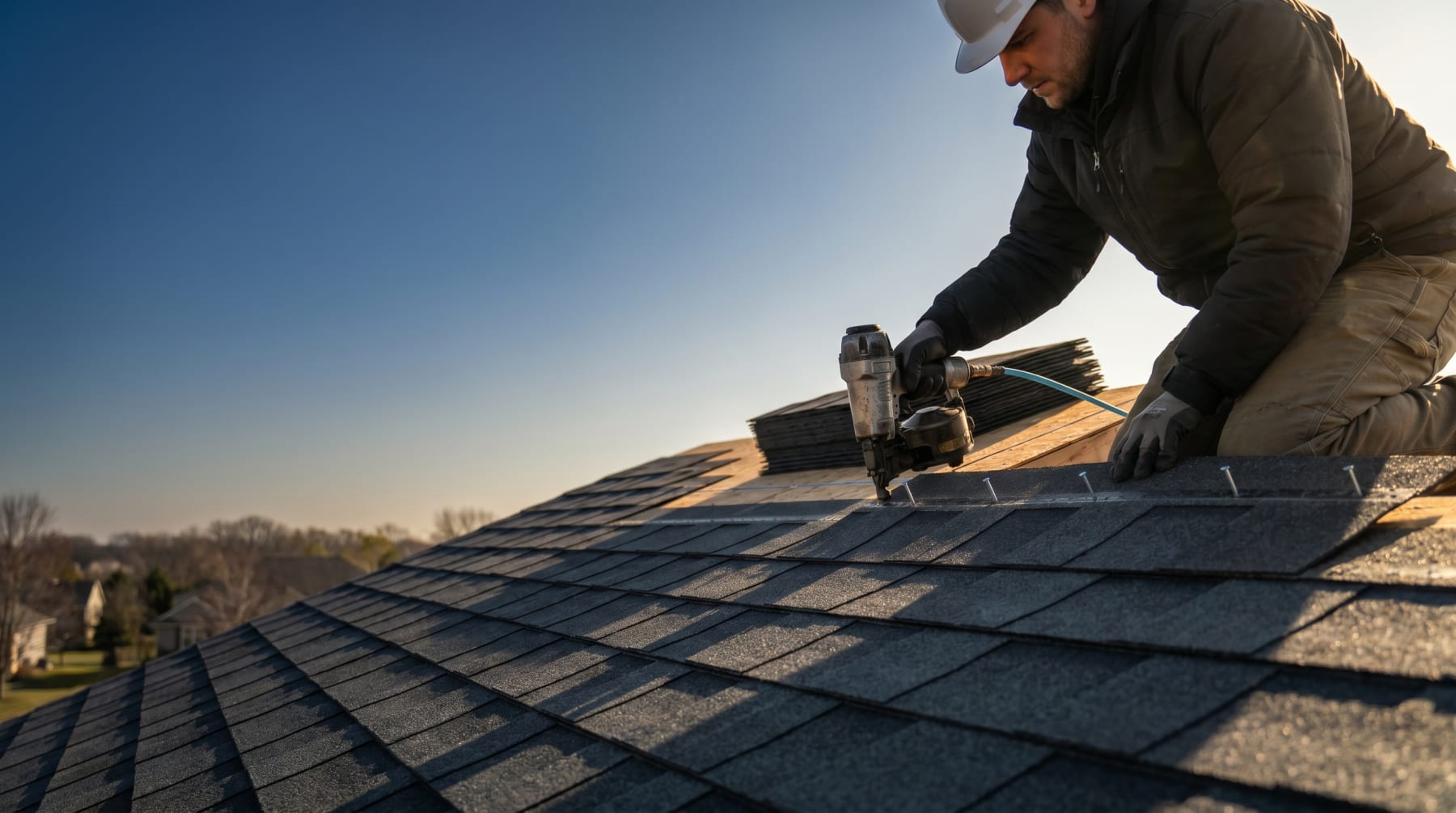
Single-piece thermoplastic polymer shingles with a 50-year service life. Master substrate prep, the six-nail pattern, thermal sealing windows, FORTIFIED standards, and Illinois compliance.
REVIA shingles are single-piece thermoplastic polymer — fundamentally different from laminated asphalt. Their longevity depends on a flat, clean, properly-attached deck. Imperfections telegraph through synthetic material and can break the thermal seal.
12mm minimum well-seasoned plywood. Thinner panels lack the density required for fastener pull-out resistance.
11mm minimum for Oriented Strand Board. Must be properly attached to rafters to prevent sagging.
Withstands 2-inch hail without fracturing — the highest UL impact rating available.
Single-piece polymer construction yields tear and nail-pull resistance roughly 2.5× greater than leading asphalt products.
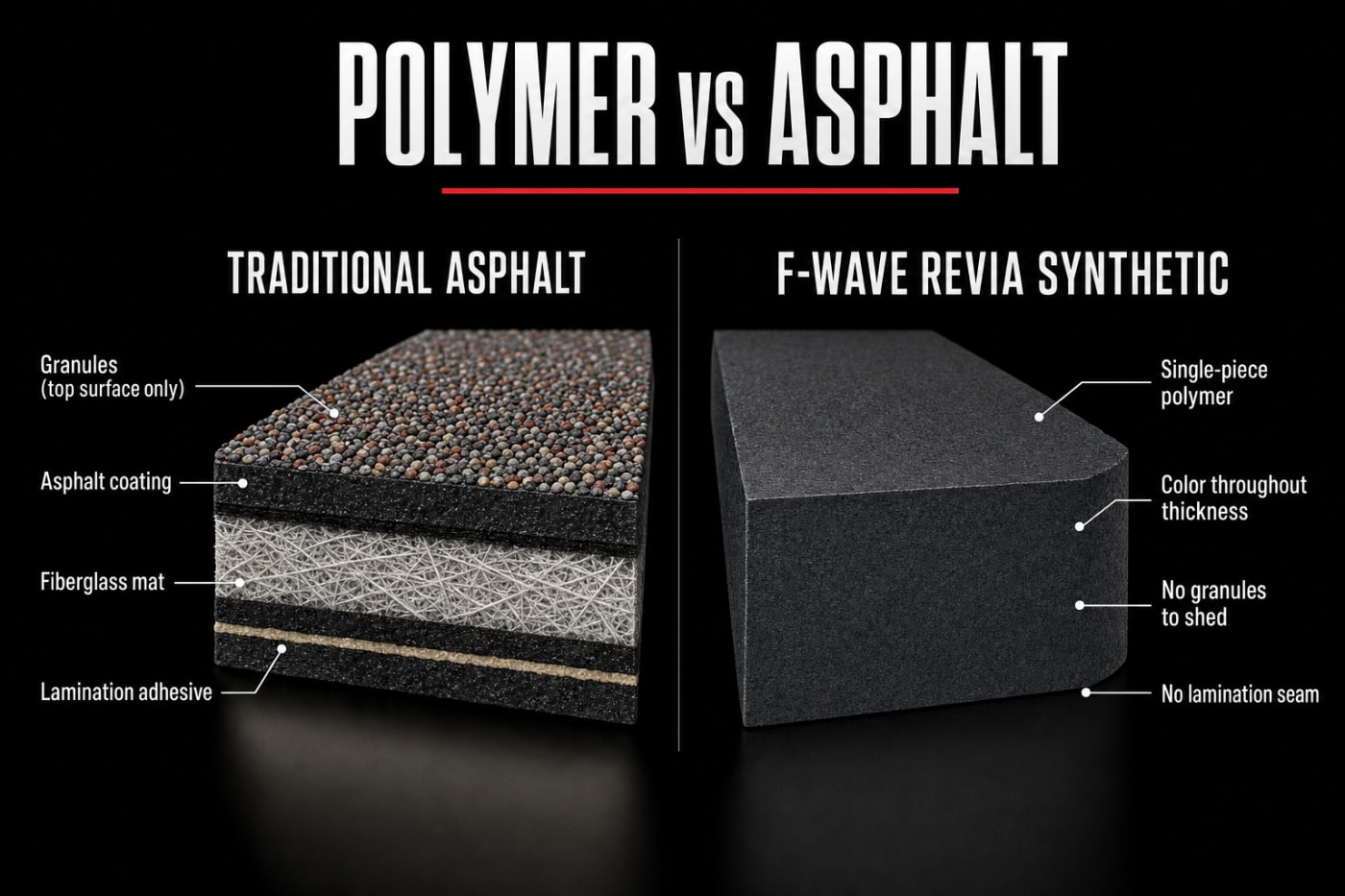
Traditional architectural shingles are laminated — two layers bonded with an adhesive that thermally degrades over a 20-year cycle, leading to delamination and granule shed. F-Wave REVIA shingles are commercial-grade thermoplastic polymer manufactured as a single, monolithic piece. Color and UV stability are integrated throughout the entire material thickness, eliminating the granule-shed failure mode and producing a "generational" 50-year service life.
| Performance Category | Testing Standard | Metric / Rating |
|---|---|---|
| Impact Resistance | UL 2218 | Class 4 |
| Wind Uplift | ASTM D3161 / D7158 | Class F / Class H |
| External Fire Exposure | UL 790 / ASTM E108 | Class A |
| Wind Warranty | Standard / XTM | 130 mph / 150 mph |
| Weight per Square | Manufacturer Spec | 185–200 lbs |
Approved substrates are well-seasoned plywood (≥ 15/32" / 12mm) or OSB (≥ 7/16" / 11mm). The deck must be smooth, flat, dry, and properly attached to the rafters — sagging or shifting will cause tabs to lift or fail to seal.
Any rotted, water-soaked, or structurally unsound decking must be replaced. Where transitions between OSB or plywood sheets are uneven, they must be planed or corrected — imperfections "telegraph" through the synthetic material, creating both an unprofessional appearance and potential wind-entry points.
F-Wave does not approve radiant barrier products as an underlayment when used with REVIA shingles, and does not allow installation on any slope below 2:12.

True or False — 4 questions, 25 pts each
Module 1 Score
The synthetic shingle is the primary water shed; the underlayment is your secondary barrier. F-Wave specifies precise ASTM standards by location — and on low slopes, the underlayment becomes the actual primary water barrier.
F-Wave requires synthetic underlayment compliant with one of three ASTM standards: ASTM D226 Type I or II, ASTM D4869 Type I or II, or ASTM D6757. Underlayment must be applied flat and unwrinkled directly to the deck — and shingles should be installed as soon as possible after underlayment is set, before UV degradation begins.
In high-stress areas, F-Wave requires a smooth-surface, non-granulated, self-adhering waterproofing membrane compliant with ASTM D1970. This membrane provides an airtight, watertight seal at the most vulnerable junctions of the roof.
F-Wave recommends D1970 membrane at: valleys, eaves, ridges, hips, pipe penetrations, dormers, slope changes, skylights, and chimneys.
For ice-dam protection in climates like Batavia, IL, the D1970 membrane must be applied at the eaves and extend at least 24 inches (610mm) up the deck from the interior side of the exterior walls.
| Slope Range | Classification | Underlayment Requirement |
|---|---|---|
| < 2:12 | Not Allowed | F-Wave installation is prohibited |
| 2:12 to < 4:12 | Low-Slope (Ornamental) | One layer of self-adhering OR two layers of synthetic across entire low-slope surface |
| ≥ 4:12 | Standard Slope | Single layer of synthetic underlayment |
| > 21:12 | Steep Slope | Standard underlayment + mandatory hand-sealing of all tabs |
On low slopes the shingles are considered "ornamental" — the underlayment is the primary water barrier because reduced pitch keeps water on the surface longer, and hydrostatic pressure can force water under the tabs.
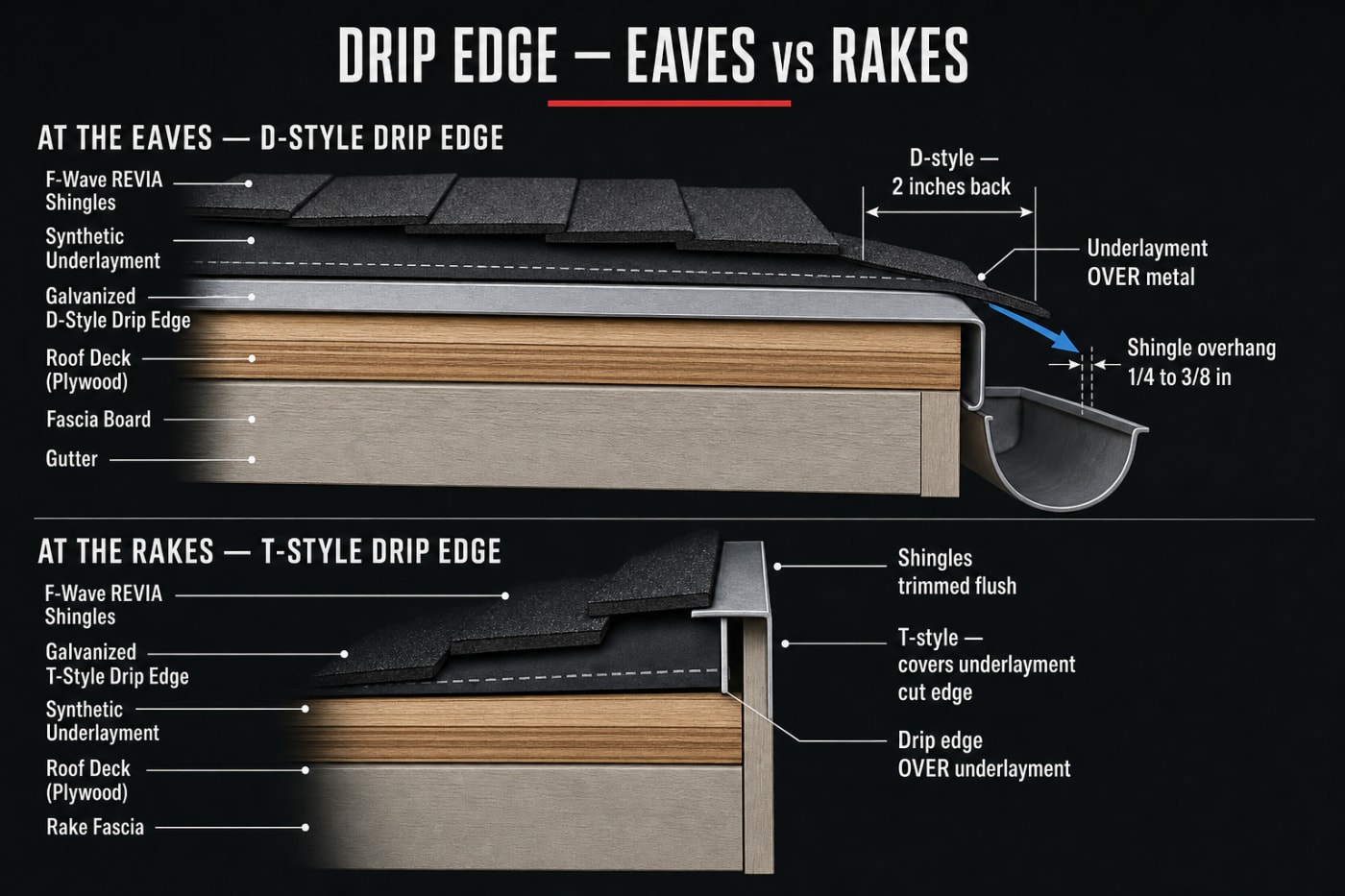
Stock metal: 6 inches wide, at least 0.019 inches thick, corrosion-resistant.
ASTM D1970 self-adhering, smooth-surface, non-granulated membrane is required at every critical junction.
D1970 membrane must extend 24 inches (610mm) past the interior wall line in cold climates.
F-Wave installations are prohibited below 2:12. Between 2:12 and 4:12 the shingle is ornamental and the underlayment is the primary barrier.
D-style at the eaves with underlayment applied over the metal. T-style modified at the rakes, with metal over the underlayment.
Drag and drop — match each spec to its requirement. 4 pairs, 25 pts each.
Module 2 Score
Polymer shingles have a high coefficient of thermal expansion and superior tear strength — fastener placement and type are what unlock the wind warranty. F-Wave specifies fastener gauge, head, length, pattern, and a six-nail minimum for ALL applications.
Required for ALL applications, regardless of slope or wind speed. No exceptions.
Corrosion-resistant 11- or 12-gauge roofing nails. Ring-shank highly recommended for withdrawal resistance.
9.5mm minimum head diameter to resist pull-through under wind uplift.
19mm minimum into the deck — or at least 1/8" (3.2mm) through if the deck is less than 3/4" thick.
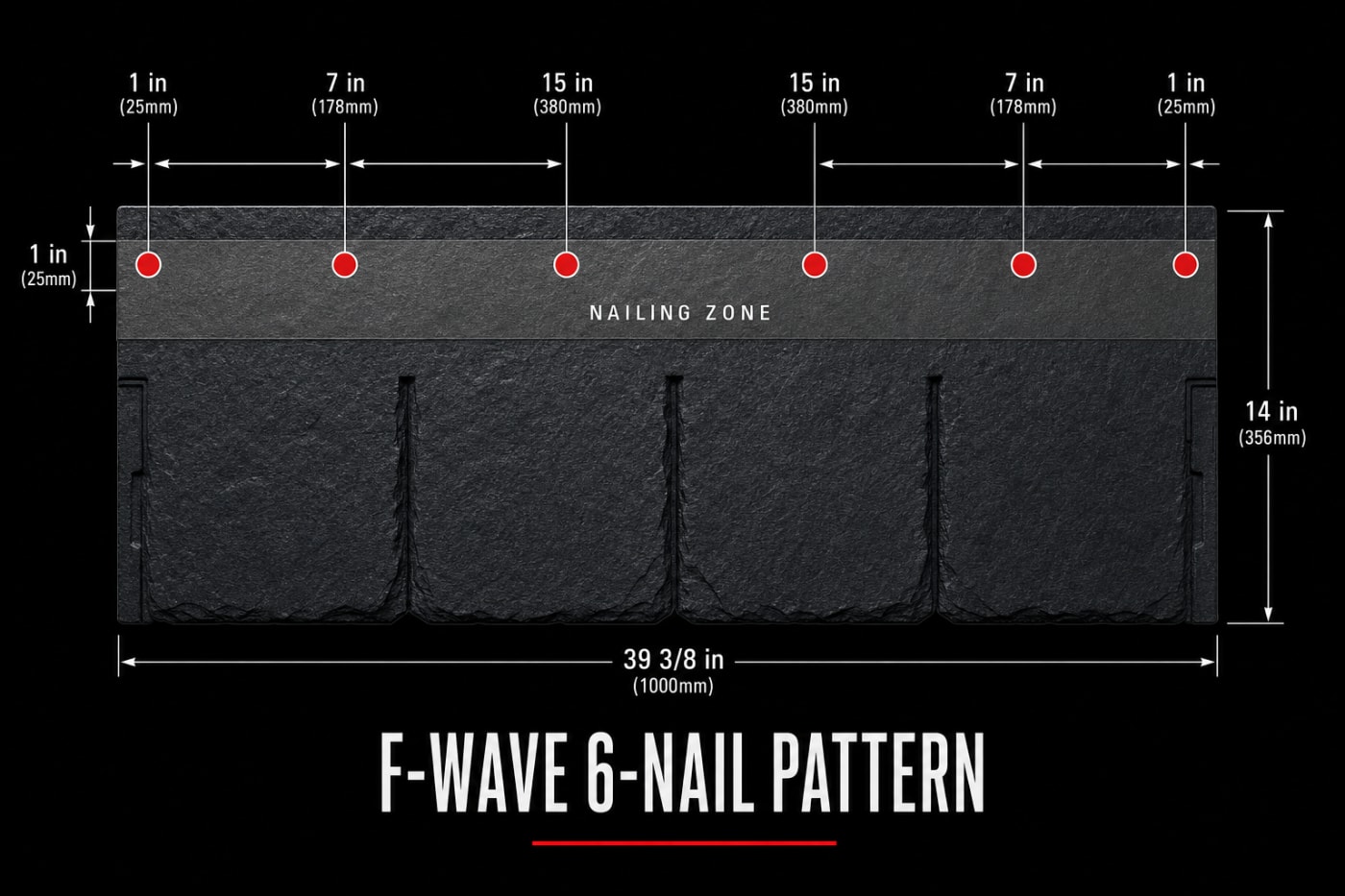
Each shingle measures 39 3/8" (1000mm) wide. Six fasteners are placed within the wide nailing zone, 1 inch (25mm) from the top of the exposure:
| Fastener Position | Distance from Shingle Edge | Rationale |
|---|---|---|
| End Nails (×2) | 1" (25mm) from each end | Prevents corner lift and ensures end-lap seal |
| Intermediate Nails (×2) | 7" (178mm) from each end | Provides lateral stability across the shingle width |
| Center Nails (×2) | 15" (380mm) from each end | Anchors the midpoint against wind uplift |
| Vertical Position | 1" from top of exposure | Hidden but inside the reinforced nailing zone |
All nails must be driven straight, with heads flush to the shingle surface. Never cut into the shingle. Never leave a nail "proud" (undriven) — it interferes with the seal of the course above. Fasteners must never be exposed on the finished roof.
Multiple choice — 5 questions, 20 pts each
Module 3 Score
A 1 1/2-tab diagonal offset is non-negotiable. Open W-style valleys are preferred. Step flashing is fastened to the deck — never the wall. And every metal-to-shingle transition needs a 1/2-inch thermal-expansion gap.
F-Wave REVIA shingles must be installed in a diagonal pattern with a 1 1/2-tab offset. The standard horizontal exposure is 6 inches (152mm). F-Wave is not responsible for roof integrity if these methods are not followed.
Two acceptable layout methods:
F-Wave requires the use of F-Wave REVIA Starter Shingles only. Cut 6 1/2 inches (165mm) off the length of the first starter strip (Estate Series), or 4 inches (Classic Slate). The starter course should overhang the eaves by 1/4 to 3/8 inch (6–10mm), or be flush with a D-style drip edge. Six fasteners are placed 1 inch (25mm) up from the eave edge.
| Course | Trim | Resulting Length |
|---|---|---|
| Course 1 | Full shingle | 39 3/8" (1000mm) |
| Course 2 | Trim 1 1/2 tabs off left | 27 1/5" (700mm) |
| Course 3 | Trim 3 tabs off left | 15 3/4" (400mm) |
| Course 4 | Trim 4 1/2 tabs off left | 4" (100mm) |
| Course 5 | Full shingle — repeat pattern | 39 3/8" (1000mm) |
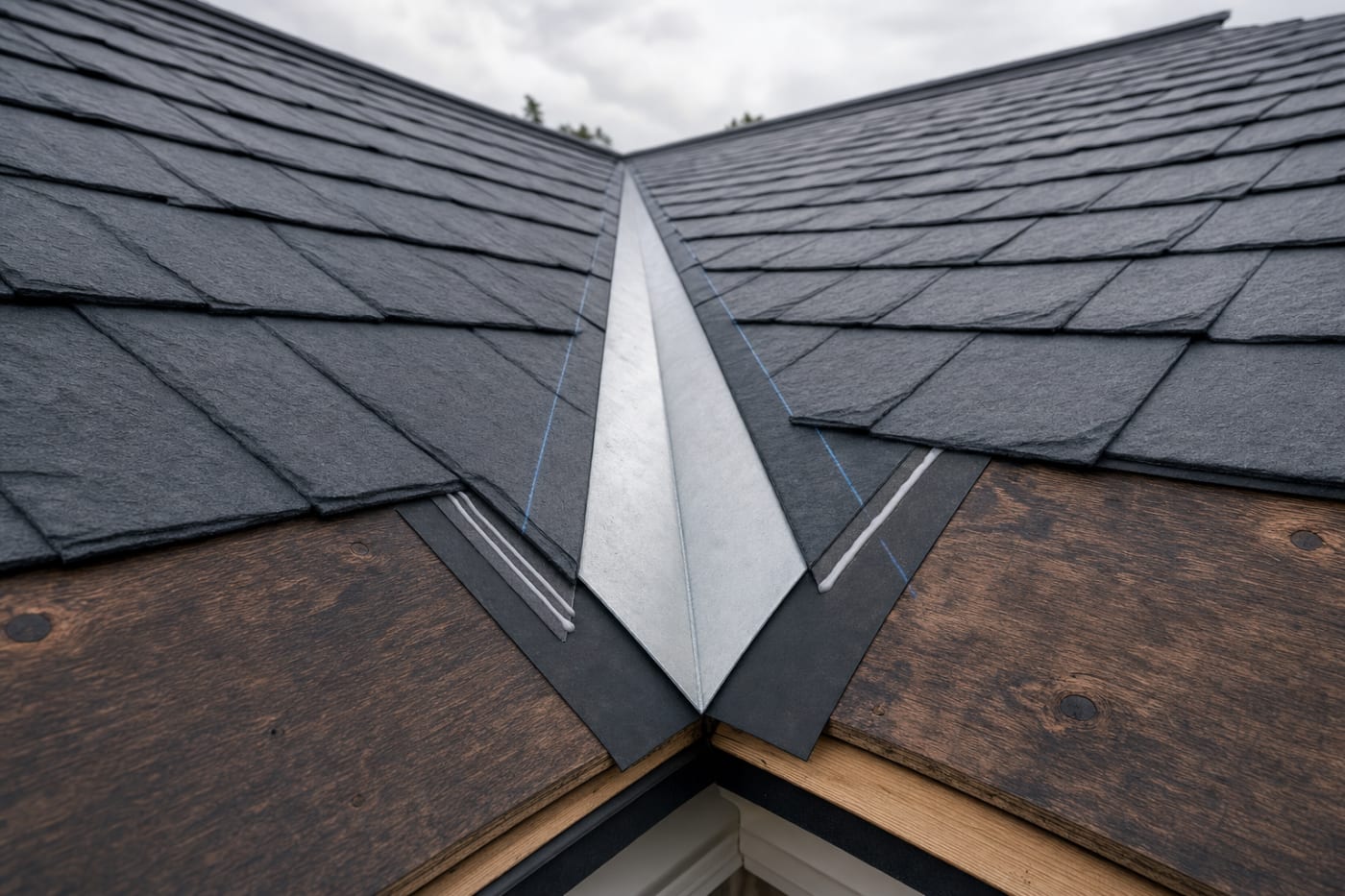
Valleys — F-Wave prefers the open valley method using "W" style metal. (Closed-cut and woven methods are NOT allowed; a closed-valley alternative using "W" style metal is acceptable.) Sequence:
Roof-to-Sidewalls — Use 8" × 8" step flashing (Estate Series) or 10" × 8" (Classic Slate). Step flashing must extend at least 4 inches up the sidewall and at least 4 inches over underlapping shingles. Overlap pieces by 2 inches. Fasten step flashing to the roof deck only — never to the wall. Use F-Wave approved sealant under the shingle to bond it to the metal step flashing.
Roof-to-Headwalls — Apron flashing extends at least 5" (127mm) up the headwall and at least 4" down the roof. Nail apron to the roof deck only; use siding/counter-flashing on top.
Hips & Ridges — Use F-Wave REVIA Hip & Ridge shingles. Two fasteners (minimum 1 3/4" length), 1" from the edge at the "Nail Here" mark. Begin at the bottom of the hip. At the ridge, start hip-and-ridge from the opposite direction of the prevailing winds. On slopes 10:12 or greater, F-Wave requires self-adhered underlayment along the hips and ridges.
Multiple choice — 4 questions, 25 pts each
Module 4 Score
REVIA's adhesive needs solar heat to activate. Cold weather, steep slopes, and high winds change the rules — and FORTIFIED standards plus Illinois code add a final layer of compliance every roofer must know.
REVIA shingles rely on the sun to activate the factory adhesive strips that bond the courses together. F-Wave requires:
Hand-sealing is required in any of the following conditions:
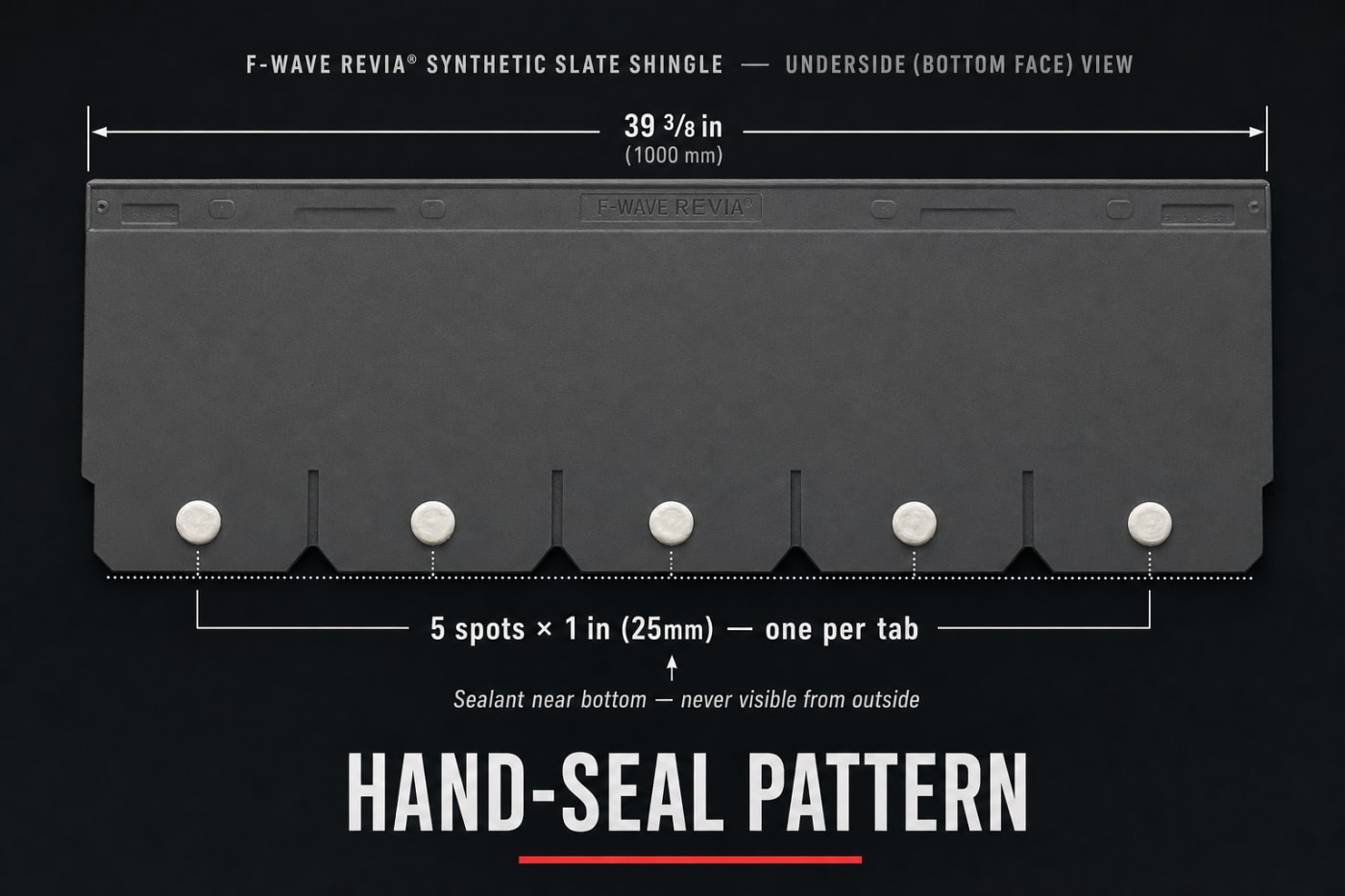
Hand-Seal Procedure: Apply five 1-inch diameter spots of approved sealant — one spot behind every tab (5 spots total per shingle) — near the bottom of the shingle. Press the shingle down into the sealant. Sealant should approach the edge of the shingle but never be visible.
For structures requiring enhanced storm resilience, REVIA shingles are eligible for the FORTIFIED Home designation developed by the IBHS. The standard upgrades the base install in three ways:
In hail-prone regions, REVIA's Class 4 impact rating already meets the IBHS Hail Supplement for 2-inch hail.
| Tool | Application | Notable Features |
|---|---|---|
| AJC Super Shear | Rakes & long runs | 21" blade, built-in fence and pitch gauge |
| Tie Down Shingle Shaper | Valleys & hip cuts | Lightweight aluminum, built-in angle meter |
| Malco Power Shear | Complex shapes / outlets | Drill-attachment with beveled lead-in tip |
| Roof Snake | Repairs / nailing under existing | Allows nailing under existing shingles without damage |
| Hook-Blade Utility Knife | Repair work, fitting penetrations | Standard tool — best for small cuts |
Storage: Pallets must never be double-stacked — the polymer will deform under load. Store on a flat, weather-protected surface. In cold climates, keep material in a heated space until needed on the roof so the polymer is pliable.
Statewide (IL Public Act 103-0510): Effective January 1, 2025, Illinois has a statewide baseline for building codes. All new residential roofing must meet the IRC minimums regardless of municipality, and roofing work must be performed by a state-licensed contractor.
City of Batavia: Has adopted the IRC for residential (Chapter 9) and IBC for commercial (Chapter 15). The Building Division requires a building permit for any re-roofing or roof recover. Re-roofing is prohibited when:
Contractors must submit their Illinois Roofing Contractor License with the permit application. Properties in the Historic District also require a Certificate of Appropriateness from the Historic Preservation Commission. Inspections are typically required after tear-off (deck condition) and at completion.
10°C and rising. Below this, the polymer is stiff and the adhesive won't seal naturally.
23°C — the rooftop temperature at which the factory adhesive softens and bonds.
F-Wave's definition of "high wind" — triggers mandatory hand-sealing of all tabs.
Five 1-inch diameter spots of approved sealant — one behind every tab — near the shingle bottom.
15 questions covering all five modules. 45 seconds per question. 20 points each. Complete the exam to unlock your certificate.
All 5 modules covered · 45 seconds per question · 20 pts each · 300 pts total
Total Points Earned
Enter your name to generate your certificate of completion.

Your training sessions are saved automatically. Log in again to start a new session.
Complete the password gate to view your history.