
IRC Training
Enter your name and access password to continue.
Enter your name and access password to continue.

The code book is as essential as the nail gun. Know it, use it, own every inspection.
Before you can master the code, you need to understand where it came from — and why a contractor in Frankfort, IL is using the same rulebook as one in Miami or Seattle.
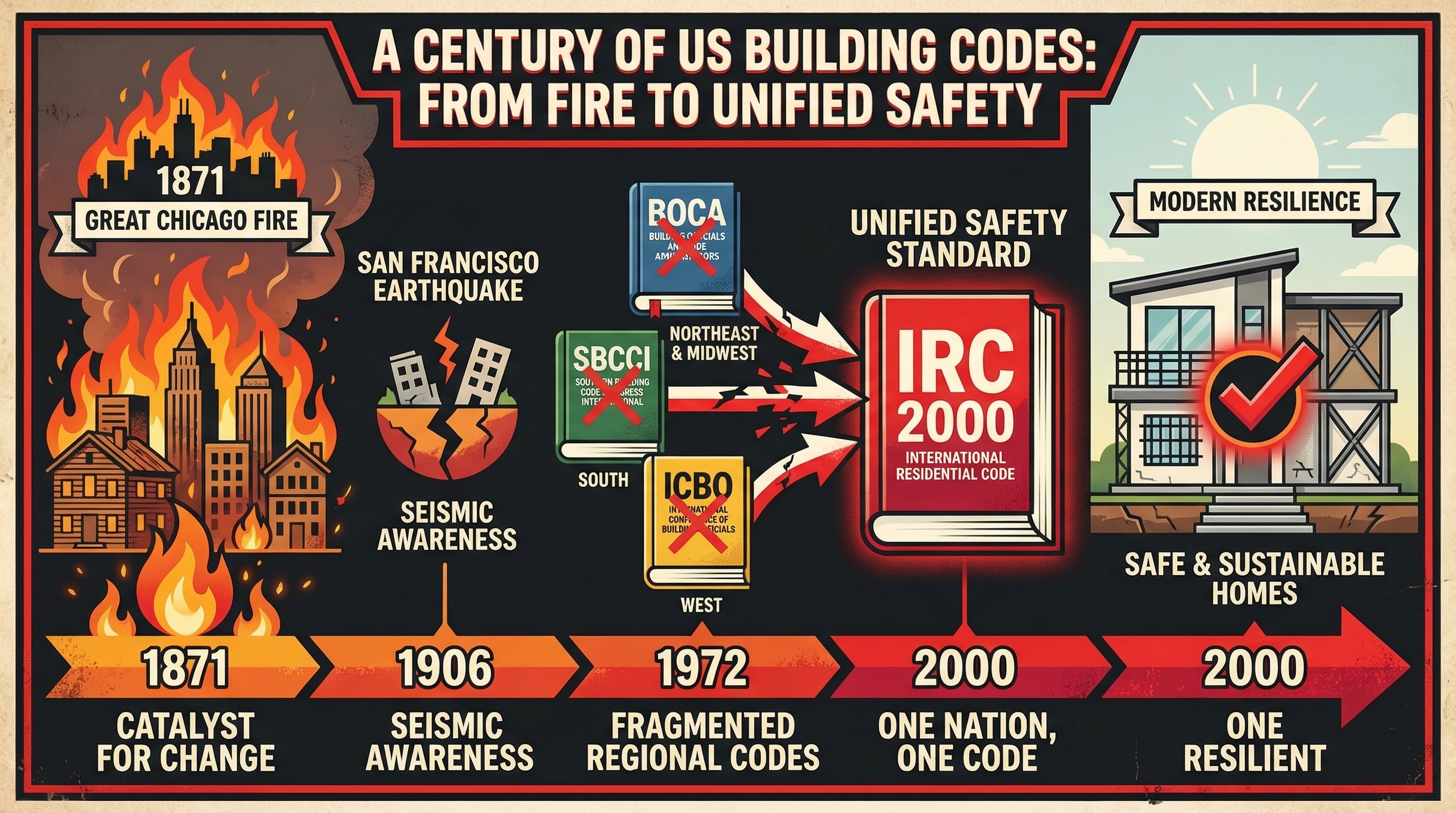
Building codes didn't come from bureaucrats in conference rooms — they came from tragedy. The 1871 Great Chicago Fire burned 3.3 square miles and killed 300 people, largely because wooden construction offered no resistance. Cities scrambled to write their own rules.
Then the 1906 San Francisco Earthquake reminded the country that fire wasn't the only threat — structural failure could be catastrophic too. Each disaster produced a new wave of local codes, each slightly different, each well-intentioned, none coordinated.
The result? A patchwork of rules that meant a roofing contractor doing jobs across state lines was essentially working in three different countries.
By the mid-20th century, three regional organizations each published their own code. Manufacturers had to test products against three different standards — driving up housing costs nationwide.
| Organization | Code Name | Territory | Primary Focus |
|---|---|---|---|
| BOCA | National Building Code | Northeast / Midwest | Snow loads, fire prevention |
| SBCCI | Standard Building Code | South / Southeast | Wind uplift, hurricane resilience |
| ICBO | Uniform Building Code | West / Southwest | Seismic stability |
For roofers, this fragmentation was especially painful. Wind uplift requirements in Florida were irrelevant in Vermont — but you still had to know which code applied where, and inspectors enforced them differently.
The push for unification began in 1972 when BOCA, SBCCI, and ICBO formed the Council of American Building Officials (CABO) as a joint venture. CABO's "One and Two Family Dwelling Code" served as a prototype for a standalone residential code.
In 1994, the three organizations merged to form the International Code Council (ICC). In 2000, the ICC published the first International Residential Code (IRC) — effectively ending the era of regional codes.
Joint venture between BOCA, SBCCI, and ICBO — first step toward unification
Three regional orgs merge into the International Code Council
First edition of the International Residential Code. One nation, one code.
The IRC covers detached one- and two-family dwellings and townhouses only. Anything bigger falls under the International Building Code (IBC). The IRC is a prescriptive document — meaning it gives you pre-calculated solutions so you don't need an engineer for every standard job.
The IRC bundles building, plumbing, mechanical, fuel gas, energy conservation, and electrical provisions into one volume. For roofers, the most critical chapters are:
Quick Facts — Click to Reveal
🔥 What sparked the first building codes? Click 📚 How often is the IRC updated? Click 🏠 What does IRC NOT cover? Click 📅 When did Illinois adopt statewide code? Click
4 questions · 25 points each · 100 pts total
Snow, wind, gravity, seismic — every force hits the roof first. Chapter 3 tells you what loads to plan for. Chapter 8 tells you how to build a structure that handles them.
R301Section R301 — Building Planning. Requires jurisdictions to publish local design criteria in Table R301.2(1) covering snow load, wind speed, seismic category, and weathering index. requires every jurisdiction to populate a Design Criteria table with minimum performance standards. This is why a roofer in Frankfort, IL and one in Crown Point, IN have different fastening requirements even though they're 30 miles apart.
| Design Factor | Code Reference | What It Drives |
|---|---|---|
| Ground Snow Load | Table R301.2(1) | Rafter sizing, ice barrier necessity |
| Ultimate Wind Speed | Figure R301.2(4)A | Shingle fastening patterns, edge metal thickness |
| Seismic Design Category | Section R301.2.2 | Roof diaphragm connection to walls |
| Weathering Index | Table R301.2(1) | Material selection for freeze-thaw cycles |
Every force on your roof — snow, wind, gravity — must travel in a continuous, unbroken path from roof sheathing down through rafters, to wall plates, to foundation. Break any link in that chain and you get structural failure.
In high-wind zones, hurricane clips or H-straps tie rafters directly to wall top plates. In the Midwest, most code inspectors focus on proper nailing of the rafter-to-plate connection. A missed strap or under-nailed connection can fail the mid-roof inspection.
First link. Transfers load to rafters/trusses via nailing schedule.
Carry dead load + live load. Span tables govern sizing.
Rafters connect here. Hurricane clips required in high-wind zones.
Terminal point. Load path must be complete and unbroken.
R802.4Section R802.4 — Rafter Span Tables. Prescriptive tables allow contractors to size rafters without an engineer for standard applications. Variables include species, grade, spacing, span, and snow load. gives you span tables so you can size rafters without hiring an engineer for every house. The tables account for:
Typical minimum for rafter sizing calculations
Varies by location — Frankfort, IL is in a moderate snow zone
Ties must be in the lower third of attic height
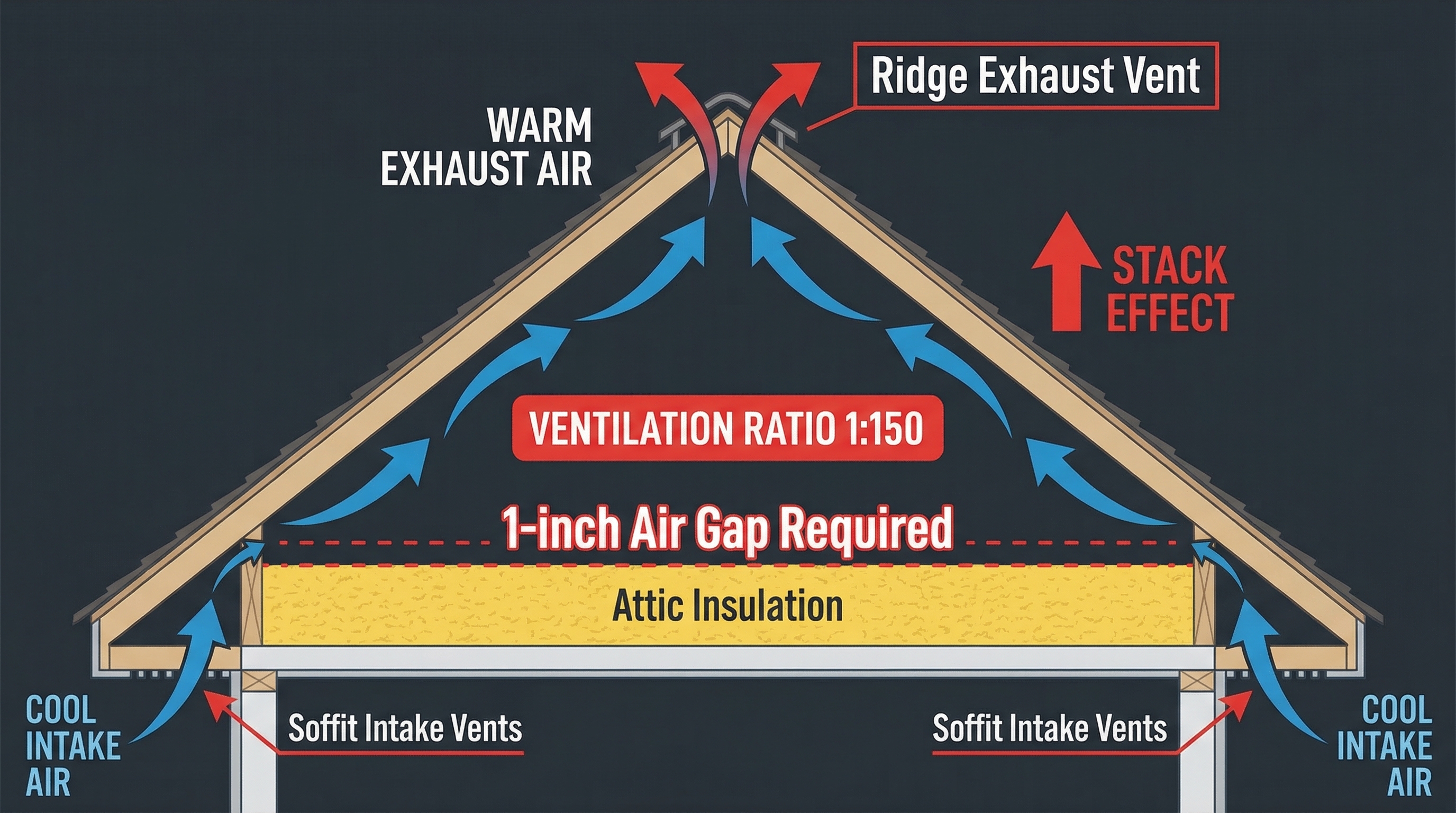
R806Section R806 — Attic Ventilation. Establishes net free ventilating area (NFVA) ratios, air gap requirements, and climate-zone exceptions to prevent ice dams and moisture damage. governs attic ventilation to manage temperature and humidity. Under-ventilated attics cause ice dams in winter and cook shingles in summer — both are callbacks waiting to happen.
| Ratio | Conditions | Why |
|---|---|---|
| 1:150 | General requirement, all vented attics | Higher airflow compensates for unbalanced or low-quality venting |
| 1:300 | Balanced 40–50% of vent area in upper half | Uses stack effect for efficient air movement |
| 1:300 | Climate Zones 6–8 with Class I/II vapor retarder | Limits moisture migration from living space to cold attic |
Drag each code section to its correct description · 25 pts each · 100 pts total
Drag the red code section chips onto the correct description boxes.
This is your daily code. Minimum slopes. Underlayment specs. Drip edge. Ice barriers. Valleys. Know Chapter 9 cold and you'll sail through every inspection.
Slope is measured as vertical rise over a 12-inch horizontal run. The material you're installing dictates the minimum slope — install below it and you're writing a callback.
| Material | Min Slope | Special Conditions |
|---|---|---|
| Asphalt Shingles | 2:12 | 2:12–4:12 requires double underlayment or ice/water shield |
| Clay / Concrete Tile | 4:12 | High dead load — verify structural capacity |
| Metal Panels (standing seam) | 3:12 | Some systems lower — verify manufacturer data |
| Wood Shingles | 4:12 | Wood shakes: 5:12 minimum |
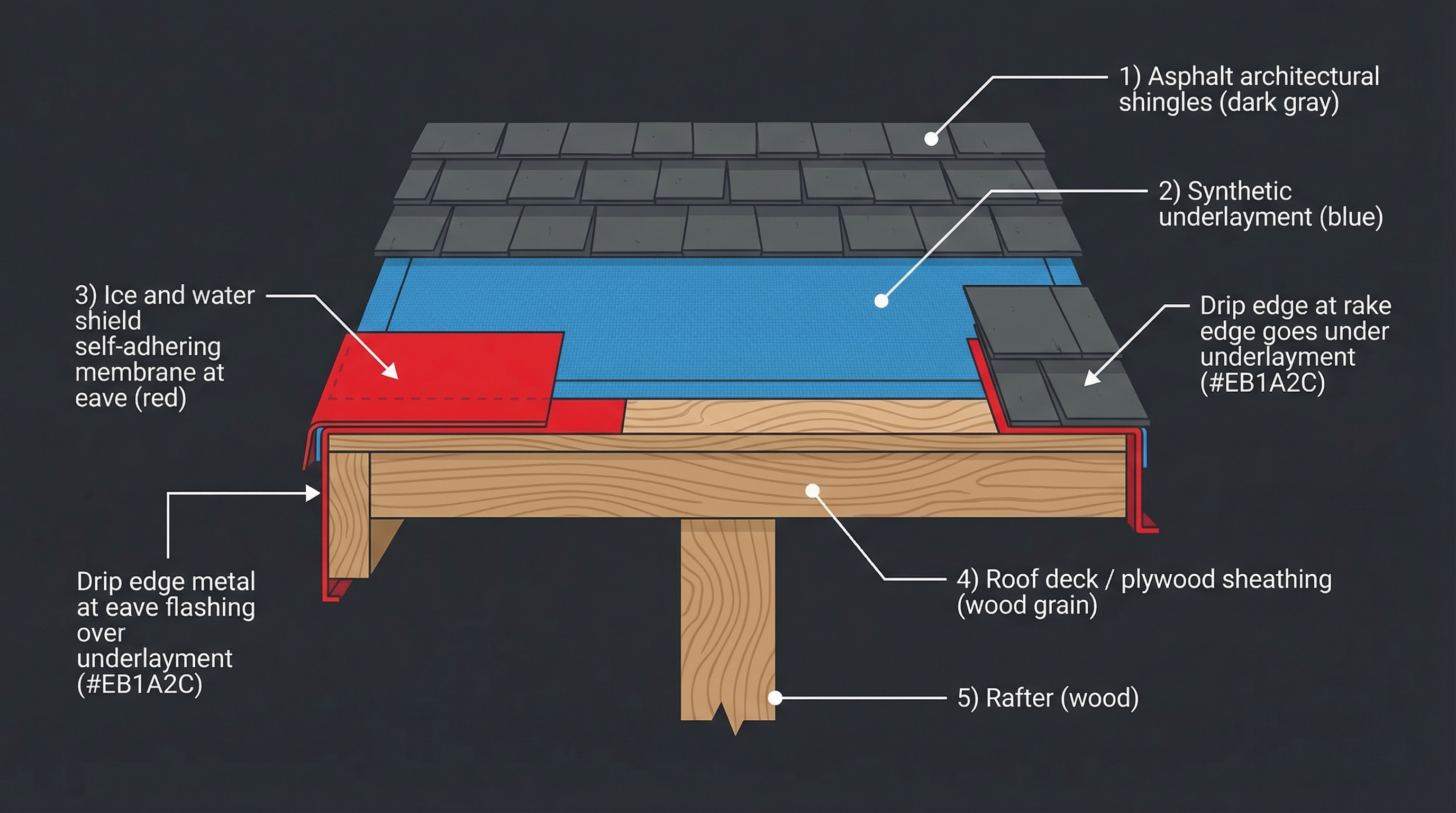
R905Section R905 — Requirements for Roof Coverings. Specifies underlayment ASTM standards (D226 for organic felt, D4869 for synthetic), installation methods, and material-specific rules for all roof covering types. mandates underlayment conform to ASTM standards. Synthetic underlayments (woven polypropylene) are increasingly common due to tear resistance — but they must meet ASTM D4869 performance criteria to be code-compliant.
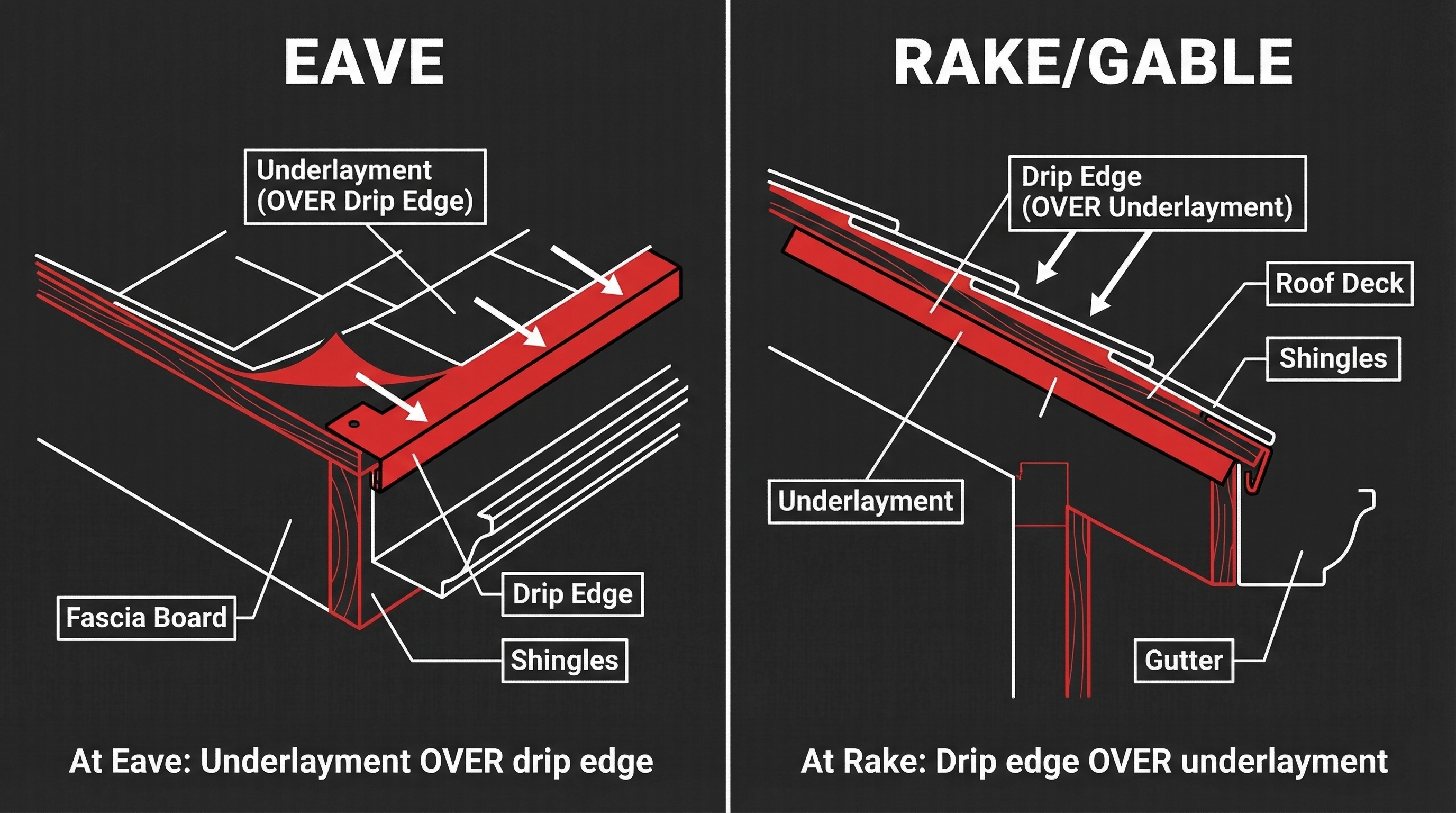
Drip edge is mandatory on asphalt shingle roofs. This was a significant code update — many older roofs have none, and contractors who don't install it are failing inspections and voiding manufacturer warranties.
26-gauge corrosion-resistant metal. Using lighter material is a code violation.
Each drip edge section must overlap the next by at least 2 inches.
Nailed to deck at maximum 12-inch intervals.
Ice Barrier — In northern climates, a self-adhering polymer-modified bitumen membrane is required from the eave edge to a point at least 24 inches inside the interior wall line. It stops water that backs up under shingles during ice dam formation from entering the building.
Valley Options:
| Valley Type | Minimum Width | Notes |
|---|---|---|
| Metal Valley | 24 inches | Corrosion-resistant metal, center-crimped |
| Mineral-Surface Roll Roofing | Two plies for open valleys | Older method, less common now |
| Self-Adhering Ice/Water Shield | Per manufacturer | Best performance for closed/woven valleys |
5 questions · 20 pts each · 100 pts total
Most of what Hamstra does is reroofing. Section R908 governs it — and starting January 1, 2025, Illinois changed the game with a mandatory statewide building code.
R908Section R908 — Reroofing. Limits roof covering layers, requires tear-off under specific conditions, and addresses the liability of concealing existing damage under new material. — A structure cannot support more than two applications of roof covering. Adding a new layer of asphalt shingles over an existing layer adds approximately 200–250 pounds per square (per 100 sq ft). On a 30-square house, that's 6,000–7,500 lbs of additional dead load — not nothing.
Per IRC R908 — never more than two applications of roof covering on any structure
Additional dead load per 100 sq ft when overlaying asphalt shingles
Even if only one layer exists, a complete tear-off is mandatory when:
| Phase | What Happens | Your Goal |
|---|---|---|
| Permit Acquisition | Submit plan + state license number | Legal authorization, credential verification |
| Tear-Off / Deck Inspection | Inspector checks deck for rot and nailing after strip | Identify hidden structural issues before covering |
| Nailing / Progress (10–40% complete) | Verify fastener type and spacing | Confirm wind-resistance requirements met |
| Final Inspection | Walk-through of flashings, vents, drains | Completion certificate, life-safety sign-off |
Illinois historically had no mandatory statewide building code. Cities like Batavia were still using the 2006 IRC as of 2024. That changed with Public Act 103-0510.
Illinois mandatory statewide building code took effect
All jurisdictions must adopt at least the 2018 IRC (2021 or 2024 also accepted)
What changes for roofers in IL:
4 questions · 25 pts each · 100 pts total
The ICC exam is open-book — but 3 minutes per question doesn't leave time for random searching. Speed comes from knowing the layout cold. Here's how the pros tackle it.
Multiple-choice, open-book format
3 minutes per question average
42 of 60 correct to pass
| Content Area | % of Exam | Key Sections |
|---|---|---|
| Roof Coverings | 45% | Chapter 9, material specs, fastening |
| Reroofing | 15% | R908, tear-off rules, layer limits |
| Insulation & Drainage | 15% | R-values, scuppers, roof drains |
| Weather/Fire Protection | 15% | Class A–C, wind zones, ice barriers |
| General Administration | 10% | Permits, inspections, stop-work orders |
| Pass | Action | Time |
|---|---|---|
| Pass 1 | Answer every question you know from memory or experience — don't look anything up | 30 min |
| Pass 2 | Questions where you know exactly which table or section to find the answer — look it up fast | 60 min |
| Pass 3 | Use the book to research the hard questions you couldn't place | 60 min |
| Pass 4 | Final review — hunt for trap words: "not," "only," "maximum," "minimum" | 30 min |
An unmarked code book is a liability in a timed exam. Build your tabs before exam day:
R905 (Materials), R806 (Ventilation), R802 (Framing), Chapter 3 (Design Criteria), R908 (Reroofing), Chapter 2 (Definitions)
Operative words: "shall" (mandatory), "may" (optional), "except" (most common test source), and all specific numbers (0.019, 1:150, 24 inches)
Write "See Table R301.2" or "Cross-ref R905.2.8.5" in margins. Saves 30–60 seconds per lookup.
The IRC updates every three years. The 2021 and 2024 editions push hard on energy efficiency and solar integration — knowing this future content gives you an edge now.
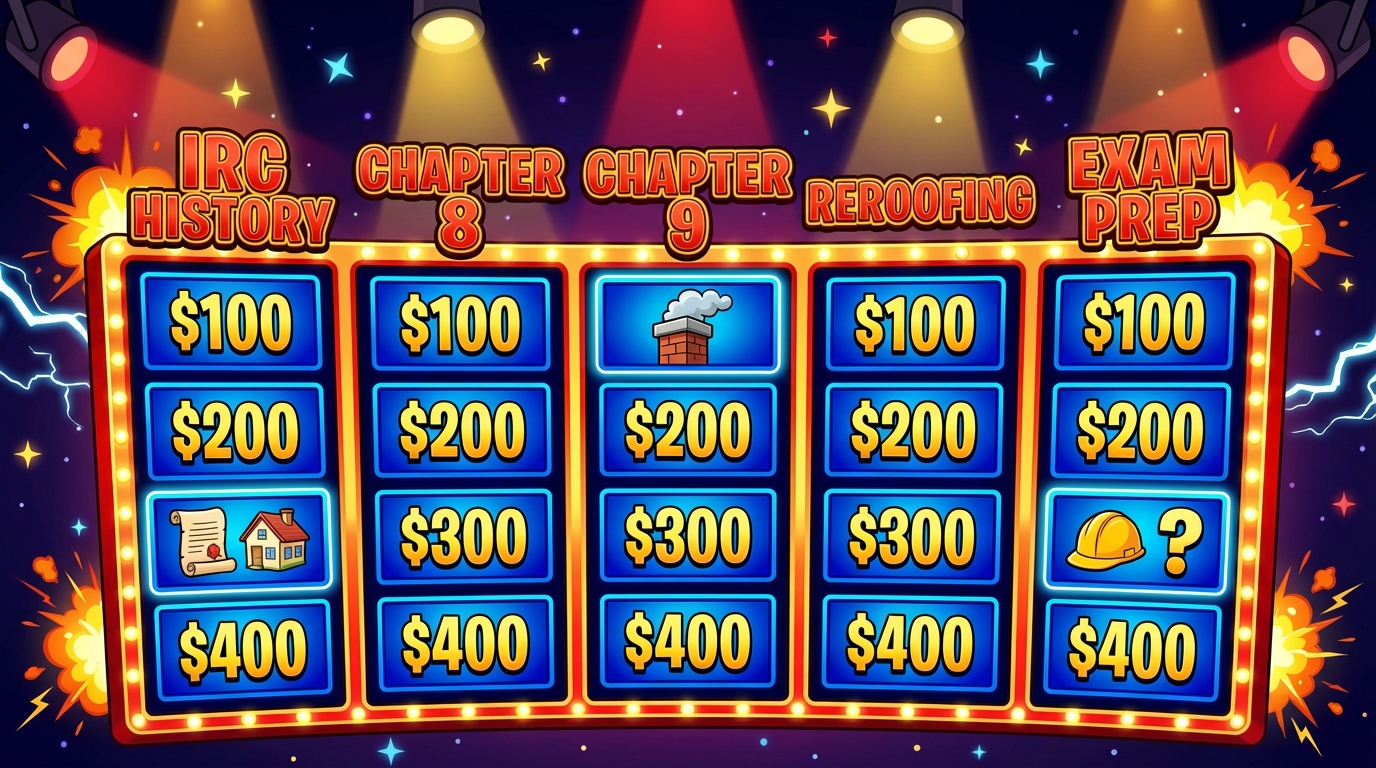
20 questions across 5 categories. Up to 200 bonus points. Think you know your stuff?
Jeopardy bonus points: 0 / 200
15 questions. 45 seconds each. Mix of everything. This is your F14 warm-up — no looking back at the modules. Go from memory.
15 questions · 45 seconds each · 20 points per question · 300 points total
Questions auto-advance when time runs out. No going back.
Enter your name below, then print or save your certificate.
Total Score / 800 pts
Your training sessions are saved automatically. Log in again to start a new session.
Complete the password gate to view your history.